Showing posts with label self image. Show all posts

Thursday, March 21, 2013

The Society you Created

I recently wrote a paper about how society has effected the ideal female figure from the 18th-20th centuries. It was quite fascinating to me how a small change in the way women acted made a big change in the way women were depicted. It got me thinking about why the ideal figure is what it is today. I've got a theory and I think it's pretty good so I'm going to share it with you! How fun.

Many people blame fashion and media industries for the way women are depicted. Technically, this is true because these are the only industries that regularly depict people, but the blame cannot all be on them. The fashion industry bases their ideal figure off of what sells and what society wants. I also have a theory about why society has created this image, at least in western societies that are predominately Caucasian.

Fashion

The fashion industry is not an all-powerful organization that decides what people want. It is a series of businesses that, through trial-and-error as well as observation of target audiences, has determined what will sell and how to sell it, just like any other business. So why does the shape of models sell?

The world today is very much about equality. No one should have to change for anyone else. There should be products available for all types of people. In fashion, that means there should be clothes for all body types.

This has produced today's ideal model. She is tall and skinny, with wider shoulders than hips, B to C cup breasts, and a narrow waist. How did this come about? It's because she is a woman of no extremes. Let's take other body types into account here.

Straight women (very small, if any, curves) often want to look like they have more curves. This is often done by cinching the waist. Outfits that have this feature make waists look smaller on most body types, so most body types will work for this group of people.

However, there are also women that are perfect hourglasses, going on extreme variations in their measurements. These women also tend to love making their waists look smaller, but they also want to play up their curves. Therefore, a woman with no curves would not be able to successfully sell clothes to the majority of these women. These women would buy clothes from any body type besides straight.

Then there are triangle or pear shaped women. These women have large hips and small torsos. They usually want to narrow their hips and play up their torsos. Straight women wouldn't work because of their flat chests, and hourglasses would have a hard time, too, because of their evenness. Triangle shapes won't look to hourglasses because they don't have compatible hips. What looks flattering on an hourglass will often emphasize hips on triangles.

And now we come to apples. Women who are apple shaped are the same shape as a model, but have a tummy. They tend to emphasize their legs and chest, and down play their stomachs. This means any outfit that emphasizes the waist or hips is out. That means any model that has big hips or no curves cannot successfully sell clothes to these women. These women will buy clothes from women emphasize long legs and small hips.

So we get strawberry shaped women. This is the shape of a model, as long as she is also tall. This is why she is the ideal body type for the fashion industry:
  1. She has a narrow waist which appeals to all body types except apple
  2. She does not have a flat chest, which appeals to all body types.
  3. She has narrow hips (but not as narrow as her waist), which appeals to all body types.
  4. She has long legs, which appeals to all body types, especially apple. 
  5. She has broad shoulders, which appeals to all body types, especially straight.
Now let's look at why the other body types are not the ideal shape in the fashion industry.

Straight
  1. She has no defined waist, which does not appeal to hourglass, strawberry, or pear.
  2. She has very little bust, if any, which does not appeal to hourglass, strawberry, pear, or apple.
Hourglass
  1. She has large hips, which does not appeal to pears or apples.
  2. She has curvy legs with larger thighs, which does not appeal to apples.
Pears
  1. She has a small bust, which does not appeal to straight, hourglass, strawberry, or apple.
  2. She has large hips, which does not appeal to apple.
  3. She has curvy legs with larger thighs, which does not appeal to apple.
Apples
  1. She does not have a defined waist, which does not appeal hourglass, strawberry, straight, or pear.
  2. She has small hips, which does not appeal to hourglass, straight, or strawberry.

It can now be reasonably deduced that tall strawberry shapes are the least extreme, and, therefore, most versatile body shape for the act of selling clothing.

Society

Now we must look at why this body type sells, in fashion and media. It can't all be about selling clothing. There has to be a reason for her to be so prominent in the media as well. There is. It can be found in the ideal women have created for themselves.

Female relationships with males

Women today want to be equal with men. We want to be able to do everything that men can do and get equal pay and credit for it. We want to go to the same schools, work the same jobs, and participate in the same activities. We want to be seen as equally smart, hard-working, and athletic. 

When it comes to body shapes, the only equality we seek that plays into it is athletic. Athletes are often seen as having larger torsos than lower body. Most female athletes follow this idea of athleticism. They are usually strawberry shaped. Many of them would be straight if they were not athletes, because their broad shoulders have come from developing their muscles. It is very rare for short, extremely curvy women to become great athletes. Why? Being a short, curvy woman myself, I think it's because of our legs and chests. Short legs have to be taught to move differently than long legs if you want the same results in sports, and the process takes longer. Then there's our chests. Good sports bras for women with large chests are hard to find and expensive. I have never owned one. Because I've never owned one, it often hurts for me to jump around and run. I cannot be the only one with this issue.

On top of that, women also want to be just as fit as men traditionally have been. There is an emphasis on health and fitness like there's never been before. In history, men have been the fit, healthy, muscular ones because they've been the ones out doing manual labor. Now there's more and more office workers for both men and women, so society has compensated with exercise programs. That's why thin is in. Thin is in because we are a society of health nuts, often going in to the unhealthy because of cutting out food groups, fad diets, normal dieting, excessive exercise, and a general desire to always loose weight. You hardly ever hear about people maintaining weight. If you just go off the media, people lose weight until they're sickly and then they have to gain weight. No one ever points out that a celebrity has maintained a weight.

Female relationships with females

The difference between women seeking equality today and women seeking equality in the past is that we also want to be seen as women. This doesn't mean we want to be seen as damsels in distress or what have you, it means we don't want to be "one of the guys." Women today want to go to the office and then go out into the world and find a man. What she wants the man for is up to her, but that's what we want to do. 

We aren't the burning bras women of the past. We like our bras, well, most of us do. We simply want to be seen as a woman who works. No also, no shock, just women on the same field as men, but still women. We've gone beyond the straight ideal body type. We don't want to look like men. We haven't gone back to the extremely fertile and feminine body type, either. We don't want to be pushed into the home, even those of us that want to be stay-at-home mothers. Women today want their choices lain before them. 

Because we want to be seen as women, the time old practice of comparing ourselves is at its best. I don't know why women do this more than men. I don't think it's because of the media. The media has simply given us more women to compare ourselves to. If you read books from history about women (how to be a lady type things), women have always compared themselves. They have never wanted to be wearing the same thing at a party. It's always been common for women to try and out-dress each other. There is no difference between them and us in this field.

So how do we change the attitude towards women's bodies that is so prevalent in our society? We have to change ourselves. I, personally, think this is a great time to be a woman. In fashion, you can find clothing for your body type in every season. If you don't like the ideal women of Caucasian society, you can switch to the ideal woman of Latin, Black, Asian, or Arab society. Or any other society you want. It's up to you! We're now in a time when women decide our ideals, not men. Yes, we're still affected by men, but they do not hold all or even most of the say in what we look like or do. We are. 

The key to not being depressed about not looking like a model is to stop trying to be one. Understand what the purpose of a model is. Understand her her job. These women, yes, are beautiful, but the model you see is trying to sell you something. Do you really want to go through life always selling something, never looking like a woman and always like an ad? Cause if you replicate how these women look in the pictures you see of them, that's what you're doing. So stop blaming fashion and the media for your poor body image and embrace the woman that you are. 

Tuesday, September 18, 2012

In defense of the photoshopped

I'm currently in a media and society class. This week we talked about photoshopping pictures. One of the topics of discussions was, "Is photoshopping racist?" This kind of really annoyed me. The examples used were two pictures of OJ Simpson, one on Newsweek and one on Time Magazine, and two pictures of Gabourey Sidibe, one on Elle and one from google images. The picture of OJ Simpson was his mugshot. On Time, the photo was altered to cast a shadow over his face, removing most of the highlights. It also blurred out the edges of everything and darkened the background. Apparently people thought this was racist because Time was trying to make Simpson look more dangerous by making him darker. The opposite was true for the photos of Sidibe. The picture on Elle was considerably lighter than her actual skin color. This, apparently, was racist because it's saying you have to be white to be beautiful.

I'm going to start with my problem with the OJ Simpson pictures. First off, Simpson's mugshot was very red. On the Newsweek cover, it completely washed out the title and headlines, which were also red. Time, which is NOT a breaking news magazine, would be more concerned with the lay out of its cover. Secondly, casting a figure in a shadow is not racist. It is mysterious. Time probably wanted to have a more suspenseful cover. I ask you, if a white man had been cast in shadow, whould that also be racist? No, it would not. So why is a black man cast in shadow racist? Darker skin was not the intent of this photo. The intent was the shadow. A shadow that would have the same effect on a white or black person.

My main issue with picking on photoshopping pictures is actually with Gabourey Sidibe's photo on Elle. In my class, a lot of people were saying the lightening of her skin was saying you can't be beautiful with very dark skin. I completely disagree. Elle is a fashion and beauty magazine. You will never see an extremely dark-skinned person shown with her actual skin tone on the cover of a magazine like that. It's not because dark skin isn't beautiful. It is. However, extremely dark skin hides necessary lines in faces when being photographed. Look at this from the editor of a beauty magazine's point of view. (Note: I am not an editor of a beauty magazine. I just happen to know about design and art. Plus I'm very interested in fashion and beauty so I pay attention to these things.) Sidibe has beautiful eye brows. Women might want to shape their eyebrows like her. How can they if they cannot see her eyebrows in the magazine? Sidibe's face is very nicely shaped, with the shape of her check bones, nose, lips, and chin filling out that shape in a very beautiful and charming way. If her photo had been left untouched, the darkness of her skin would have flattened her face out. Did her skin have to be lightened as much as it was? Probably not. Did it have to be lightened in order to show off the natural beauty that is in the shape of her face? Yes. Real life and photographs are different. Untouched photographs of almost anyone are not going to sell magazines simply because things that naturally occur when mixing skin and cameras will flatten faces, make faces look oily, create a skin tone that is not accurate, etc.

The camera also adds ten pounds. I'm not joking. You can look super skinny in real life one day, but a picture of you will look averagely skinny. Can you blame editors of photos for taking cellulite out of pictures? Is there an easier way to shed those ten pounds? This photoshopping can go overboard very easily in feature articles. However, in advertisements, I don't think this does go overboard. Advertisements are meant to sell a product, not a person. If the height of the model's shoulders will distract from the product, then it is perfectly ok to move them. Some people just have weird proportions. In an advertisement, anything that is proportionatly off will detract from the product. Model's are photoshopped into a "perfect" person in order to detract as little as possible from the product.

This is often criticized as making the standard of beauty unreasonable. While I can see the reasoning behind this argument, I disagree. I will bet you anything that young girls compared themselves to eachother before the camera was even invented. Girls and women have always compared themselves. There has always been someone prettier, someone you could never hope to even compare to in beauty. All photoshopping in magazines has made following celebrities even more seperated that it already was.

Now, I am not a parent, so I am taking a guess here, but I think self image is rooted in the home. While the teenaged years are rough, I believe the poor body image common in these years can be grown out of based what was taught in the home. Parents have more affect on their children than it seems like anyone cares to admit. If the parents of a young woman don't tell her how pretty she is, how her eyes sparkle when she smiles, then that young woman will never believe it when she's a woman and a man is telling it to her. If parents don't teach young girls not to compare themselves to other girls because everyone has their own qualities that make them beautiful, that girl will never stop comparing herself to others even after she is a grown woman.

I'm begging you, consume media responisbly. There will always be something to take offense at if you don't. Understand the type of media you are consuming. Understand the messages the magazines you subscribe to are trying to send. Before you accuse a magazine of being racist or setting a bad example for the yound and impressionable, think of what that magazine is trying to do. Society can't be blamed for all of the problems in the world.

Friday, September 7, 2012

Put your behind in your past

Yesterday I had a conversation with a friend about loving yourself for who you are. Once again I had too many thoughts to say in one conversation so I'm going to put them all up on the internet! That's what the internet is for, right?

Way too many people use "love yourself for who you are" as an excuse. I think the meaning of this has been twisted by society. There has been such a focus on condemning models and celebrities for giving us a skewed idea of beauty and it drives me nuts. As I told a friend once, models are picked because they wear the clothes well. A fashion designer doesn't want everybody looking at the model, they want everybody looking at the clothes. The fashion industry knows this. The designers that design for people shaped like a model rarely go far. Girls like me have a hard time finding clothes that fit, not because clothes are designed for models, but because the average girl has considerably less curviness to their bodies. If clothes were produced for girls shaped like me more girls would complain about how they fit. Instead of hearing girls complain about how they can't wear button down shirts or they have to wear baggier shirts to fit their hips, we'd be hearing more girls complaining about how they can't fill up the tops of shirts, how everything is baggy and will only fit them around the waist.

Why does this matter? Because I want it to be somewhere on the internet that says you can love yourself for who you are and still want to look better without it being unhealthy. "Love yourself for who you are" doesn't mean accept the hand that has been given you. I truly believe it means love your personality and body type.

I feel I can use myself as an example of loving yourself for who you are because I have struggled with this and come out on top. I love myself for who I am. I don't wish I had another body, but I work hard to make sure my body looks as good as it can. The biggest thing I struggled with was my skin. I was born with skin that is prone to acne and boils. I had skin that hurt for a long time. Over the counter acne treatments would help for a little while but none of them lasted. If I had decided to "love myself for who I am" as it is understood by many people today, I would still struggle with this constantly. It has not gotten better as I've gotten older and in fact has gotten worse. I decided it was worth it to take the extra time to take an antibiotic and my skin has cleared up considerably.

This might not be the best example because that is skin and this is normally aimed at weight. I would like to point out that I started the antibiotics because of comfort, not looks. When you're a healthy weight you feel better. I have never heard someone say "I wish I was fat again." When it comes to looks, love what you have and work so you can love what you don't love. I'm not saying get plastic surgery or something. I'm saying if you're over weight, work to be a healthy weight. If you are a healthy weight and you don't like the shape of your body, find flattering clothes. Remember that no one can wear every style, not even hour glass shapes (for girls) or extremely v-shapes (for guys). I'm hour glass shaped and many people seem to think hour glass shaped girls can wear anything. This is false. I cannot wear shirts that are baggy and then come in around the hips or most empire waist things. I also look horrible in yellow. I don't know why cause my skin tone should look good in yellow... I know this, so I don't wear those types of shirts no matter how much I like the shirt/dress. Clothes really can help body image.

The same thing goes for other features you may or may not like. For example, I love my eyes and lips but I hate my nose. How do I not fret about my nose? I accentuate my eyes and avoid makeup styles and glasses that might bring attention to my nose.

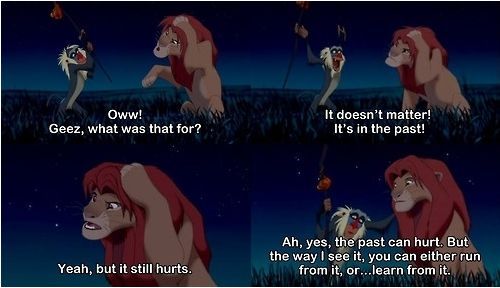
Now that I've spent so much time on physical appearance, it's time to say what I think that phrase really means. I don't think it's supposed to be about our bodies. I think it's supposed to be about out personalities. I don't think I'm alone when I say I could spend hours listing my faults. Everyone has them, no one has exactly the same faults as anyone else. I think "love yourself for who you are" means to love yourself even though you have faults. Again, this doesn't mean you shouldn't work on yourself. I just think it means love yourself while you strive to make yourself a better person. There is no reason you should hate yourself. You might hate things that you've done, but that should never keep you from loving yourself. Rafiki said this better than I ever could.


Rafiki was teaching Simba to love himself for who he is. That's really what The Lion King means to me. Simba still has his faults at the end of the movie, but he doesn't hate himself anymore.