Thursday, March 6, 2014

Parts of Fashion: Expression

The second biggest part of fashion is expression. This is really a subset of comfort, but that's why comfort is the biggest aspect of fashion. In order for clothes to sell, they have to make a person feel like they are expressing themselves. There are several different ways people express themselves with clothes.

Casual Expression

Just because you look fine doesn't mean you feel fine.
For a lot of people, especially those who are still in school or only work part time, casual expression is the most common type when it comes to clothes. This is what you wear when you aren't working. This type of expression is different for everyone, though it is rather similar in concept. I have three examples of different types of casual expression.
  1. When I was a senior in high school, one of my close friends stopped wearing graphic tees. She would still wear jeans, but she always had her hair and make up done and wore blouses. She said she decided to treat everyone like a future employer, so she didn't want them to see her wearing anything that could compromise that relationship. While she dressed nicer than most other high school seniors, she still had a level up for business wear.
  2. A long-time friend and former roommate of mine is most commonly seen in jeans, a graphic tee and Converse that almost don't count as shoes anymore. She always looks comfortable. A lot of people think she's a tom boy, and she can act that way sometimes, but she also likes make up (though she doesn't have time to put it on most days) and other girly things. The point is that she doesn't dress to impress other people on a day-to-day basis because she doesn't feel the need to. She has a comfortable, laid-back personality and that's the way she looks.
  3. I have several friends who will change level of formality for no apparent reason (and I'm included in this group). These friends will wear a funny t-shirt one day and a collared shirt the next. They may even switch between jeans, shorts, khakis and slacks. I have found that this group is the most common group. Everyone has their own reasons for doing this, but I think it's generally pretty similar to why I do it. I dress in accordance to my mood. While I try to always look nice, some days are graphic tee days and others a blouse days. Who I am seeing that day usually doesn't effect what I choose to wear (if it's a true casual day). I always try to look like I took at least a little time with my appearance. However, if I'm having an "I don't care, I just want to wear something" day, I'll grab a graphic tee. If I'm having a low self-esteem day, I'll grab something nicer and more flattering. When I was single, I would usually wear something a little more flattering if I was going to see the guy I liked, and I still do this when I want to distract my husband (cause it's so fun), but I don't wear anything that I think looks bad, so who I am seeing doesn't tend to change what I wear. Most of my friends that switch formality for no apparent reason seem to do the same thing.
Casual expression is the form of expression that is least thought about. Most people don't even think about what they're trying to say with their clothes on a regular basis. This comes as second nature to most people. Even people who say they don't care about clothes do this. They have reasons they pick their clothes. All you have to do is dig a little and they'll realize it (we did this as an assignment in one of my classes last year).

Business Expression

Business expression is the most
effected by the opinions of others.
I hope that this is a no-brainer, but I'm not so sure based on some of the "business attire" I've seen in my classes. If you're going into any type of business, you need to figure out what the dress code is. Then you can channel your personal expression through that code. The point of business attire is to impress your employer, or future employer if it's an interview or sit-along. The hard part with this type of expression is keeping your identity, which is why I think so many people don't like dressing up. I have some tips for keeping expression in this world so you don't feel lost in the crowd.
  1. Find expression in your hair or accessories. Most places that require a uniform will let you wear things like rings or earrings, so this works for most fields. Find an accessory identity. Maybe you're like me and a simple ring on one finger is enough for you. I didn't get my ears pierced until I was 16, so I got used to wearing minimal jewelry. I always had a simple ring on my left middle finger and a watch (often a bold one). I feel naked if I forget my ring (which is now a wedding ring) and watch. I also try to have unique hair. I get bored with my hair easily, so I get it cut a lot since I don't want to dye my hair. Perhaps you find identity in your hair with a dye job. That's up to you, it's your identity.
  2. Find tops with flair. In most business attire slacks are appropriate. However, slacks are boring. Tops do not have to be boring. If you're a man, bright colors and interesting patterns are a great way to add some flair to your look. For women, find tops with ruffles or applique or patterns. Blouses come in all styles. You may be bored with your pants, but there's no reason to be bored with your shirt.
  3. Get some fun socks. This, of course is reliant on your shoes. If your shoes aren't sock appropriate, get some fun shoes. My favorite shoes are black and white hounds-tooth flats with a big, flat, black bow on the toe. My favorite socks look like popcorn boxes. Fun socks can be hidden by pants and fun shoes come in business appropriate styles. There is no excuse not to have fun feet.
It's OK to conform to dress codes. Very few dress codes are so strict that they will take away all your forms of identity.

Formal Expression

Formal expression is a lot like casual expression. You get to pick what you're saying with what you're wearing. Red carpet is a great example of this. You can tell which celebrities like making a scene, which ones want to be seen as classy and which ones are incredibly comfortable with their bodies based on what they're wearing. This form of expression is basically casual expression dressed up, so I'm not going to elaborate.

Alexander McQueen is one of my favorite designers
because of the expression I see in his clothes.
Designer Expression

The fashion industry isn't just concerned about the expression of the consumers. Yes, a consumer must find expression in the clothes in order to want to buy them, but the designer has to find expression, too. If you commonly buy your clothes at Walmart, this form of expression is incredibly watered down, but it's still there. At some point in time, a designer had to be inspired by a style in order for it to be created in the first place. Designers are artists, or they should be (the good ones are), so when you buy clothing, you're wearing someone's art. While this form of expression is incredibly important, the designers that survive are able to channel their expression into something that consumers will also find expression in.

It doesn't matter if you wear non-descript clothing or incredibly flashy clothing. What you wear is your outward expression of your personality. If a piece of clothing doesn't fit with your personality, you're most likely not going to wear it. In fact, you probably won't even pick it out at the store.

Tuesday, February 18, 2014

Parts of Fashion: Comfort

I've decided to do a series of posts of on what I view as the most important parts of fashion, starting with the most important, comfort. Comfort is the number one reason people choose the wear what they wear. Keep in mind, this is wearing clothes, not buying them. Many people, I might even say most, buy clothes that are cute, cool, super chic, whatever, and leave them to hang forever in their closets, never to be worn. Tim Gunn calls these clothes "Those Items that -- For Reasons Unknown -- You Never Wear" in his book A Guide to Quality, Taste & Style. I would say that there is one reason. You don't feel comfortable in it.

There are different types of comfort. Some types may not apply to some people, all may apply to others. I may not even know all of them. Sure, I analyze clothing and why I wear what I wear, why others wear what they wear and why certain styles stick and others don't, but that doesn't mean I have figured out every type of comfort. I am a mostly self-taught when it comes to fashion theories. I do think I have a good start on the list, and I'm open to other ideas.

  1. Mental comfort. A huge part of fashion is self-expression (which I will go more in depth on in a later post). Since self-expression is so big, it only stands to reason that, if a piece of clothing does not accurately represent you, you will not want to wear it. A lot of people don't seem to think about what their clothes say about them, but I think it's because it comes naturally to people...because of comfort...no way.

    To test this theory, I would talk to people I didn't know very well (aka was sitting next to in a class), and tell them about a fashion class I was taking. I would bring up how clothing is our first form of communication, that what we wear is an expression of ourselves and you can tell a lot about a person just based on their clothes. Most of the time the person would look at me skeptically and ask me what their clothes say about them, if they are so telling. I would then tell the person my first impression of them, which was based on their clothes (as most first impressions are. I call it the first-first impression). The people I talked to were always impressed at how accurate I was.

    I concluded, based on my experiment as well as studies and books I've read, that people automatically wear clothes that make them mentally comfortable.
  2. Situational comfort. There are clothes that are made for certain events. An evening gown is not typically worn to work and athletic clothes are not normally worn on dates (unless it's an athletic date). Some clothes are made to cross events, but only with a change in combination. People generally do not want to under- or over-dress, even if it happens more often than anyone wants to admit.

    Imagine you're having a pick-me-up day. You're not feeling so hot and you want to feel better about yourself. What do you wear? Does it depend on how you're making yourself feel better? I bet it does. If you pick yourself up by binge watching your favorite TV show while chowing down on snacks, I doubt you are wearing the outfit that flatters you the most. No one else is going to see you, so you wear whatever you want. If you're the type of person that needs to get out of the house to feel better, I would wager that you are wearing a casual outfit that you feel the most attractive in. Perhaps you go somewhere fancy when you feel bad. You're probably wearing your nicest outfit. Each situation calls for a different outfit.

    Now imagine you're going to work. What do you wear? A uniform? Casual clothes? Clothes that can get dirty? Traditional business attire? Trendy business attire? Does it depend on where you're working? Of course it does. Would you feel uncomfortable coming in something else? I would say most people would say yes.
  3. Physical comfort. This one, I think, is the most obvious. No one wants to wear something that's itchy or pulling funny or falls off all the time. OK, maybe someone does, but I can't understand why. I don't think this needs much explaining. The best example I can think of is, when people are adamant that fashion means nothing, they always say "I just dress to be comfortable." Upon further prying, they usually mean physically.
While I may have spent this entire post talking about personal fashion, it can't be denied that this plays a big part in the fashion industry. It doesn't matter how innovative, cool-looking, awe-inspiring or awesome a piece of clothing is, if no one will feel comfortable in it, it won't sell and the item will disappear from the shelves. Comfort is the biggest aspect of personal fashion, but it does not completely make up personal fashion, which is why there will be more posts to follow!

Wednesday, January 8, 2014

The Marketplace of Ideas gone bad

Sometimes I am bothered more by peoples' reactions to statements that may bother me than the statement itself. Not always, but sometimes. I've wanted to express why this bothers me for a while now but I haven't been able to figure out a way that really encompasses the issue. It took me a while, but I have finally found the heart of the problem so I can now fully share my opinion.

The heart of the problem is not exactly what people say, but the reason why they feel they can say it. I went through many different theories like the internet and ego, but the real reason, I believe, is a misunderstanding of the Marketplace of Ideas.

For those of you who do not know, the Marketplace of Ideas is the concept that, if all ideas are allowed to be spoken, the true/good ideas will win out over the wrong/bad. It encourages debate and discourages censorship. All in all, this is a pretty great idea. I really like it. However, there is a bit of a misunderstanding that I have seen a lot lately.

Accompanying picture to Takei's quote. I enjoy it quite a bit.
Here is a quote from George Takei's Facebook page from a Jan. 1. 

"In the "marketplace of ideas" BAD ideas get devalued in public discourse. When people are called to face the music for their statements, while others rally to defend their ideas, this is that marketplace in action. We DON'T need to defend the right of people to say stupid or incorrect things without PUBLIC or consumer repercussion. We DO need to defend their right to say them without GOVERNMENTAL censure."

I really like this quote. I think it's a pretty good description of the Marketplace of Ideas. I do see one problem, though. It's the last sentence. I would argue that censorship does not just come from the government, it can come from the public as well.

You see, responding to a statement that resonates as false to you with what you see as truth is discourse. Something as simple as "I don't agree. That's dumb" is discourse. Ceasing to support a public figure, organization, company, what have you because you do not agree with them is also a form of discourse. It allows for others to support the idea, to respond with further ideas along the same thought process, and it will commonly end with the better idea winning out. It might take a while, but it will eventually happen.

Lately I have been seeing a lot of people responding to ideas they don't like by demanding action against the speaker of said idea. Notice the use of the word demanding. They don't say things like "I'm going to stop giving you money" or "People who disagree, let's unite and take action." It's usually something along the lines of "Person's boss, fire them." I see that as censorship, not repercussions. Now if the boss of a person that says something many see as dumb feels that it is in the company's best interest to remove that person, then that is one thing, since corporate speech is included in the Marketplace of Ideas. If the person is a public figure of some type for a company then the company has a right to get a new public figure that will say things that follow along with the company's standing. 

But what if the person wasn't out of line in terms of company policy? One group of people demanding that person be fired, especially a loud group, is terrifying. Imagine there is no company involved. Imagine you said something that you believe to be truth and the response was not an I disagree, here is another idea, or I'm not talking to you anymore. Imagine it was, instead, along the lines of lose your money, your job, your home, your social standing, etc. yelled at you from all sides. Isn't that kind of terrifying? It would make most onlookers not want to speak up. And that is censorship.

My biggest problem with demanding action in this way is it encourages silence. Silence is what kills the Marketplace of Ideas. Encouraging silence from people with a certain idea is not winning at public discourse, it is simply creating more silence. What eventually happens is you get a silent majority, which is a very real thing in everyone's lives.

If you are in a classroom with 30 people and the professor says something you agree with, but the next several people, say 7, who speak disagree with the professor, how likely is it that you're going to raise your hand and say you agree? Unless you have a strong personality, the likelihood is that you will stay silent. Even if you do raise your hand, what is the likelihood that others who support the idea will? Not very likely. So you will never know if more people agree with the 7 against or the 2 (you and the professor) for, even if everyone else in the class agrees with you and the professor. 

The Marketplace of Ideas does not hinge on "the loudest wins." For it to function correctly, it must rely on society picking the best idea. If the people supporting the not-so-great idea are louder than the people with the best idea to the point of terrifying them into silence, the system fails. The system will also fail if the people with the best idea terrify the not-so-great idea people into silence. Why? Because terrifying into silence is not allowing society to decide, it is censoring select groups into submission.

Saturday, November 16, 2013

Do no harm: Feminism from the point of view of a strong-willed non-feminist

I just read a very good article about how feminism affects men. I agree with the entire article, but it did get me thinking about men's role in feminism.

I don't claim to be a feminist. I don't feel like society is making it hard for me to be all the woman that I want to be. Perhaps it's because I've never really felt like I fit in with women. I grew up with only brothers. My closest friend in elementary school was a boy. In 5th grade I decided to learn the drums, and it wasn't to prove a point like the only other girl I knew who was also learning drums. I picked it because I wanted an outlet and I thought it would be fun. From that point on I knew I had to prove myself, and I rose to the challenge. I was the first 7th grader from my middle school to go to state on anything for the state music competition, and I went on a solo. I was in several honors bands and I was first chair in many of them. I was snare captain of the drumline and drum co-captain the next year. In college, I have been in two bands. One I was asked to join because they needed more percussionists and I can play 4-mallets.

When it comes to "being in the world of men," I have never felt wrongfully challenged. When I have been challenged by a guy, it was either because I was too shy to show what I could really do, or, in one case, the guy was so absorbed in himself that he couldn't take any direction. I didn't take that one personally because he treated a lot of the guys the same way.

The only times I have felt wrongfully challenged have been by women. In high school I lost drum captainship for unknown reasons, but I can reasonably assume based on following actions that it was because my female band director did not like me. I personally think she felt threatened by me because she was always talking about how hard it was to be a woman in a "man's profession" and she hated that I was thriving on a "man's instrument." The only other time was in college. The band I was offered a place in had 3 guy percussionists and 2 girls. One of those girls seemed to hate me. She couldn't let me do anything without first showing me how. It was very frustrating to me because I could not offer any help to her. She was very catty and seemed to hate that I didn't have to audition. The guys, however, readily accepted me. When they offered me help, they would do it nicely and ask first.

So what was the point of that story? So you can understand my opinion of many feminists. Based on my experience, confidence is the number 1 factor in being accepted somewhere. While I know that sexism does exist, most of  the stories I have been pesronally told (not read) sound like the woman is being too sensitive. It also seems like a lot of women put themselves in situations that they cannot handle. So many women go into a male-dominated situation and immediately try to "be one of the guys" but get offended when they are treated like a man. They then start to hate men, call them pigs and claim to be injured in some way.

Feminists that I respect are women who go into the world and act like women and expect to be treated with respect. These are the people who can speak for the rights of women and get attention. I may not agree with everything they say, but I can respect where they are coming from.

So where do men play into all of this? Are they hurt by feminism? My answer is yes and no. I'll start first with no.

The way I understand feminism is that women want an equal position in the world as men. In marriage, that does not mean the wife dominates the husband. It means the wife gets equal say as the husband. In the work place it means that women have every opportunity men are given based on equal qualification. It means that women have just as much chance of acheiving any goal as men.

When this is the goal, there is no harm to men. The only harm men can possibly get from this type of feminism is self-inflicted. The men who are threatened by strong women need to grow up. When it comes to ability, men and women are pretty evenly matched unless a physical element is brought in. Men who don't want to be up for a promotion against a woman should stop whining and work harder to get that promotion. I can tell you, most women have already worked pretty darn hard to get on equal footing as men in most offices.

However, there are types of feminism that severely harm men. Women who take their feminism too far, put down men, under-value men's contributions to society and claim they can do everything without men is harmful. That does not build women up, it simply tears men down. While this is not the goal of most feminist organizations, it seems to be the goal of many women. I understand that these women were probably hurt at one point, but it just shows an immaturity on their part. There is nothing different between that and men claiming superiority over women. No one is superior based on sex. Women who fall under this category not only harm men, they harm women.

Friday, October 18, 2013

Friends may come and go, but family is forever

I haven't written in my blog since I got married and I'm not sorry about that. I've been enjoying my husband and working hard in school and at my job. Today I have some free time and a thought, so I figured a blog post would be a great place to put that thought.

I've been thinking a lot about family recently. I have a little family right now and it's going to get bigger in March, so of course it's on my mind. But I want to expand on family. I want to go beyond siblings and parents. I want to talk about extended families and how important they are. My mom would always tell us friends may come and go, but family is forever all the time when I was little. It drove me nuts, but it's one of the most true statements I've ever heard.

I have three very different sides to my family. On one side, we don't really talk much. My dad moved the farthest away of his siblings. Most of his sisters still live in or around Portland, so we didn't see them a lot. However, we still enjoy each others company when we do manage to be in the same place at the same time and you can feel the love.

The other side of my dad's family talks even less. We see each other even less. I can't even remember meeting one of my aunts on that side. A lot of people who talk about their families and describe them like this tend to pair it with they don't really know or care about them. But I still know this side cares about me. And I hope they know that we care about them. 

The last side of my family is incredibly close. My aunts and uncles on that side are spread across the Midwest and West, though they're moving into a more centralized location slowly. Even though there was distance between us, I still feel a strong connection to them. I know how they are doing and they know how I am doing. We're so close that I have been called an aunt to my baby cousins and now I've heard my cousins referred to as aunts and uncles to my unborn child. Granted, most of that comes from Grandma, who confuses her words a lot, but other people in the family have made the same slip.

So what's the point of this blog post? Because it never ceases to amaze me how important my extended family is to me and how much they care about me no matter which type of extended family they are. I never want to be separated from them. I wanted to share a few examples from my life about why family is so incredibly important and the many different ways I know love to be shown.

  1. I've had a few people question my relationship with one of my grandpas when they found out I can only remember talking to him on the phone once--when I got engaged. But I don't question how he works. One of my brothers is a lot like him. I think this is the hardest type of person to recognize love from, but, once you recognize it, it's amazing what you see. When we go visit him, he'll call us every time he changes location for hours before we're scheduled to arrive. Our theory is he's so worried he'll miss us that he's being extra careful he won't. When I called to tell him I was engaged and an estimate wedding date, he was the only family member who asked me more questions than just about my fiance and the upcoming wedding. In fact, he hardly asked about that at all. He congratulated me and proceeded to ask me questions about my schooling and work and life. When we visit him, he lets us do whatever we want. Once we visited him and basically slept through the entire visit. And he was fine with that! He went in a room with my dad and they talked music. When we woke up, he fed us the best salsa and refried beans in the area and we had a lovely time. I've never met someone who is so happy just to see his family. That, I tell you, is love. And I appreciate what he has taught me about recognizing love in quiet people.
  2. The other side of my dad's family shows love in the exact opposite way. I have a few different examples of their love and they're all good, so this section may be long.

    First, I would like to share a story about my grandma. Close(ish) to two years ago, we surprised her for her birthday by showing up to her party. My older brother and I flew to Portland from school and my parents and other brother flew in from Wisconsin. Grandma hadn't seen my older brother for many years, and, when she saw him, she stopped her conversation with my dad, kind of pushed past him, screamed and hugged my brother for a very long time. It was as if she didn't even see the rest of us standing there waiting to surprise her. Of course, she had, and we visited and talked and caught up and it was great. I have never questioned that my grandparents love me or anyone else in my family because they won't let us.

    Now for some cousin stories. The first time I realized that my cousins on that side of the family loved us, even though we are the oddball Midwestern family, is when we went to a reunion a few years ago. SO many cousins came up and hugged me and I only recognized one of them. And that was just through Facebook. It's kind of hard not to recognize the tall, bald cousin with an adorable little family. Especially when there's only one of them.

    I have another cousin who is at BYU with me. We worked together my freshman year and she willing switched her custodial duties to cleaning toilets just so she could spend more time with me. I can go on much longer on all the ways she's shown me that she loves me even though we hardly saw each other growing up, but I think that's a pretty obvious way right there so I'll move on.

    The last cousin story for this family I have is from my honeymoon. We started our cruise in Vancouver, BC. I knew I had family in that area, so I posted on Facebook that we would be there for a weekend if anyone wanted to visit with us. I wasn't really expecting much of a response, but I got one. We were asked if we could make it to Victoria, but we couldn't and those cousins were a little disappointed. We had other cousins who scheduled their trip to Vancouver around us so we'd be there at the same time. We met up with the cousins who live in Vancouver and got Ethiopian food (delicious) and went to a really awesome gellato place (also delicious). The thing is, we've hardly ever seen these cousins. They're actually my dad's cousins and we only see them at reunions. So if they weren't family, it would be kind of like making plans to meet obscure friends. But they are family, so nothing was obscure and we all had fun and it was wonderful just to visit.
  3. My mom's side of the family is the closest extended family I have, as I mentioned. So I'm just going to mention a few of the most endearing things about them.

    When I got engaged, my uncles were all concerned that Jeremiah would treat me right. They seemed more concerned than my parents (though I know if my parents thought that concern was necessary with Jer, they would have said something). Jer met all of those uncles before we were married.

    My aunt tells my mom quite often that she hopes we stay in Utah because she likes having us around. She has us over once a month for dinner and has offered to help with our baby. She has four kids of her own and she wants to help with a baby. That, my friends, is love.

    My aunts basically threw my open house in Utah. I just asked for their help and all I ended up doing was making some cookies and getting table clothes and napkins. They made everything pretty.

    My little cousins have all been so excited to see me. I was always amazed that they remembered me at all. They've told me how skinny I am, how pretty I am, how talented I am (in a variety of ways) and have all gone through a stage of following me everywhere. Except one. I think she just wanted to be different. She's funny.

    Most importantly is my grandparents. There's no way for me to express how much my grandparents love me and the rest of my family. My grandma always gets excited when I call. My grandpa took me to Idaho for a break from some very terrible roommates. They got me a Kitchenaid for Christmas this year. And not just any Kitchenaid, an artisan sized one. Because they found out I didn't have one. My grandparents will do anything for their children and their grandchildren.
Basically, family loves in all different ways. It is incredibly sad to me when someone shuts out their family for anything but the best of reasons (like health or safety concerns). If I could help all people see the ways that they are loved, I would. My only hope with this blog post is that maybe someone will read it and realize that their family loves them and they just haven't seen it yet.

Tuesday, April 23, 2013

Dove "Real Beauty" Campaign

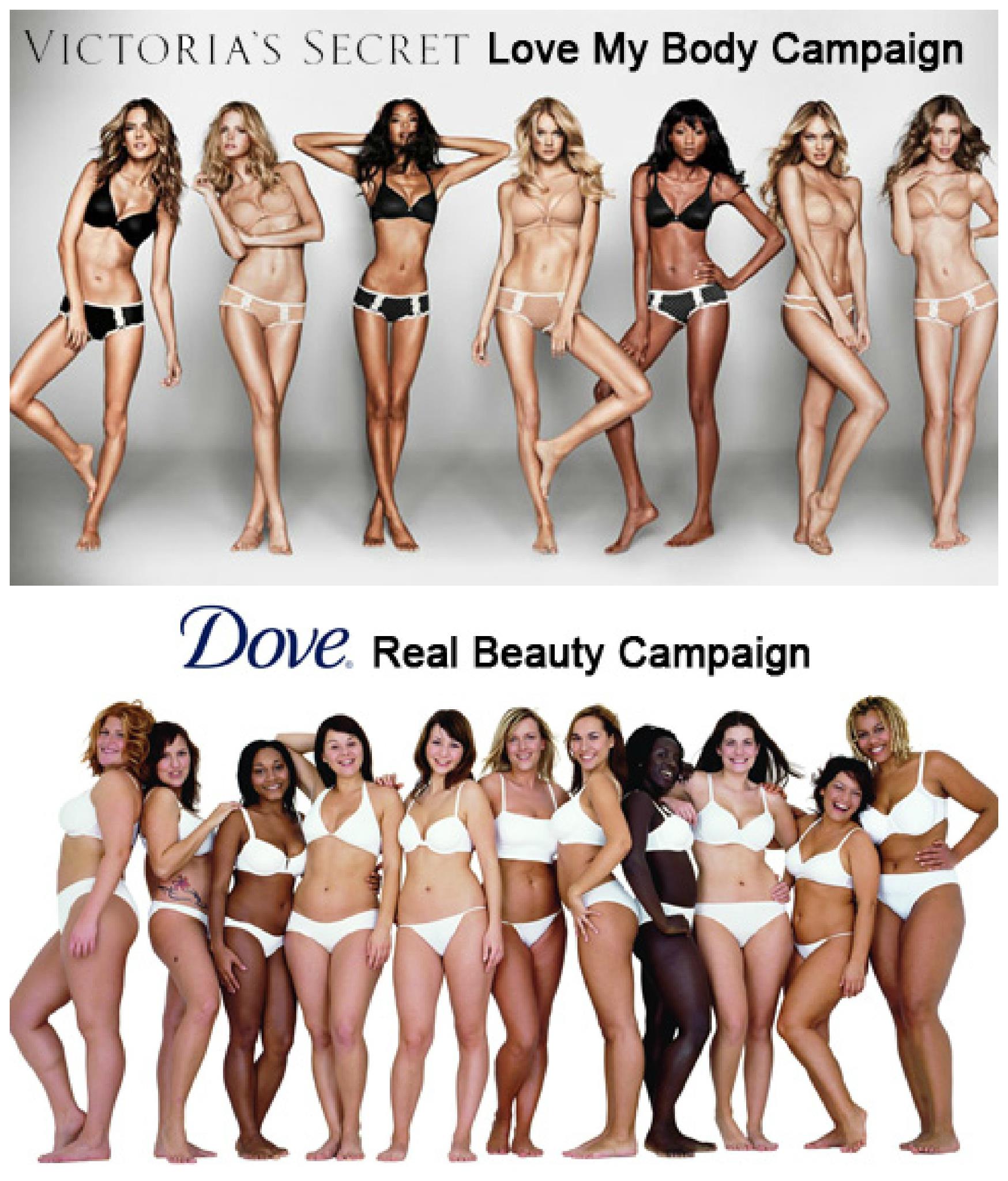
Since Dove came out with their "Real Beauty" campaign in 2004 I have had a problem with it. I've understood where the company is coming from and I have thought that they have done it wrong. I don't like that they, like all other modeling jobs, stick to a narrow body type. Where are the apple shapes? Wear are the extreme pear shapes? Where are the ruler shapes? What about the strawberries? Sure, that's the shape of a model, but they're beautiful, too.I didn't like that they were trying to fight the over-sexualizing of women by using women in underwear.  People give Victoria's Secret a hard time because their models are so sexualized. I saw only three differences between Victoria's Secret and Dove.
  1. Victoria's Secret sells bras, panties, lingerie, etc. Dove sells soap, deoderant, shampoos, etc.
  2. Victoria's Secret models are very skinny with large breasts and fairly young. Dove models are extra curvy hourglasses that are late-20s and older. And none of the Dove models look like they really tone much.
  3. Victoria's Secret models are wearing interesting bras and panties (lacy, piped, pushups, whatever you want). Dove models are wearing plain bras and panties.
Another thing that bothers me is their check-box pictures. I don't find this appropriate. Who said that freckles aren't beautiful? There are freckled models and actresses. Who said gray hair isn't beautiful? There are also older models and actresses that have gray hair. In fact, there are quite a few people who think grey hair is distinguished. I see no difference between men with grey hair and women with grey hair and I'm marrying a man that's going grey and I will never let him dye his hair. Why? Cause I think it's sexy. My mom also told him that, if he dies his hair, he can't marry me. So why can't women have grey hair and the beauty of it go unquestioned? And wrinkles! Everyone will get wrinkles at some point. But there's a difference between an older woman with wrinkles who has taken care of her skin and one who has not. Don't make excuses for people not taking care of themselves. It's lazy.

But the one that bothered me most was this one. Boy or babe? What the heck is that all about? Since when does having short hair make you a boy? And the girl doesn't even look boyish! She has a fairly feminine face! Perhaps it's just because my hair is always short that this one bothers me so much. It also makes it look like Dove was stretching since there's definitely models with short hair. Have they never watched America's Next Top Model? Someone always gets her head shaved. Short hair is beautiful and striking. It's for those of us that have a wild side but don't want it to be so in-your-face as it could be. We're bold and brave and aren't attached to our hair. We understand how freeing it is to get your hair off your neck! So are we boys or babes? Babes! There's never been a question! Even if a girl purposely wants to look like a boy, she's still a babe. You know why? Cause she's trying something different and being herself.

But what really got attention, I think, is their video, "Evolution." I get why it got so big, I really do, I just don't agree with it. The point of the campaign is to make us feel beautiful, right? So why would you point out that this one girl needs so much work done to get to billboard ready? How does that make her feel? Also, who doesn't look better after putting on makeup and doing her hair? If you don't look better, you're doing it wrong. Yes, there's photoshopping, but the whole beginning part is just rude. I get that it's supposed to point out that what we see in the media is not reality, but why do you have to start before hair and makeup? To prove your point? Well good for you. You've touched the souls of so many women, but you've made this model and probably many other models feel horrible, like they're only pretty if they have photoshop to touch them up, even if their hair and makeup is done and done well. Bravo.

But my opinion is changing about the campaign. Why? Cause I think they finally got it right with their new video, "Real Beauty Sketches." The video doesn't make a person feel ugly. It doesn't show us that "media" is horrible, even though it's media itself. Instead, the focus is on the body image of the women. It's pointing out that women see all their flaws. Do I think they picked the most drastic ones? Yes. Do I think that's ok? In this case, yes. It's like doing a study on body image. You're going to find people who have a good body image along with the people that have bad body image. They used the most extreme changes so that they could most effectively reach their target audience. Instead of making a group of people feel ugly, this one simply helps women feel more beautiful. Dove, give yourself a pat on the back. You've finally got it right. It may have taken nine years, but you did it.

Thursday, March 21, 2013

The Society you Created

I recently wrote a paper about how society has effected the ideal female figure from the 18th-20th centuries. It was quite fascinating to me how a small change in the way women acted made a big change in the way women were depicted. It got me thinking about why the ideal figure is what it is today. I've got a theory and I think it's pretty good so I'm going to share it with you! How fun.

Many people blame fashion and media industries for the way women are depicted. Technically, this is true because these are the only industries that regularly depict people, but the blame cannot all be on them. The fashion industry bases their ideal figure off of what sells and what society wants. I also have a theory about why society has created this image, at least in western societies that are predominately Caucasian.

Fashion

The fashion industry is not an all-powerful organization that decides what people want. It is a series of businesses that, through trial-and-error as well as observation of target audiences, has determined what will sell and how to sell it, just like any other business. So why does the shape of models sell?

The world today is very much about equality. No one should have to change for anyone else. There should be products available for all types of people. In fashion, that means there should be clothes for all body types.

This has produced today's ideal model. She is tall and skinny, with wider shoulders than hips, B to C cup breasts, and a narrow waist. How did this come about? It's because she is a woman of no extremes. Let's take other body types into account here.

Straight women (very small, if any, curves) often want to look like they have more curves. This is often done by cinching the waist. Outfits that have this feature make waists look smaller on most body types, so most body types will work for this group of people.

However, there are also women that are perfect hourglasses, going on extreme variations in their measurements. These women also tend to love making their waists look smaller, but they also want to play up their curves. Therefore, a woman with no curves would not be able to successfully sell clothes to the majority of these women. These women would buy clothes from any body type besides straight.

Then there are triangle or pear shaped women. These women have large hips and small torsos. They usually want to narrow their hips and play up their torsos. Straight women wouldn't work because of their flat chests, and hourglasses would have a hard time, too, because of their evenness. Triangle shapes won't look to hourglasses because they don't have compatible hips. What looks flattering on an hourglass will often emphasize hips on triangles.

And now we come to apples. Women who are apple shaped are the same shape as a model, but have a tummy. They tend to emphasize their legs and chest, and down play their stomachs. This means any outfit that emphasizes the waist or hips is out. That means any model that has big hips or no curves cannot successfully sell clothes to these women. These women will buy clothes from women emphasize long legs and small hips.

So we get strawberry shaped women. This is the shape of a model, as long as she is also tall. This is why she is the ideal body type for the fashion industry:
  1. She has a narrow waist which appeals to all body types except apple
  2. She does not have a flat chest, which appeals to all body types.
  3. She has narrow hips (but not as narrow as her waist), which appeals to all body types.
  4. She has long legs, which appeals to all body types, especially apple. 
  5. She has broad shoulders, which appeals to all body types, especially straight.
Now let's look at why the other body types are not the ideal shape in the fashion industry.

Straight
  1. She has no defined waist, which does not appeal to hourglass, strawberry, or pear.
  2. She has very little bust, if any, which does not appeal to hourglass, strawberry, pear, or apple.
Hourglass
  1. She has large hips, which does not appeal to pears or apples.
  2. She has curvy legs with larger thighs, which does not appeal to apples.
Pears
  1. She has a small bust, which does not appeal to straight, hourglass, strawberry, or apple.
  2. She has large hips, which does not appeal to apple.
  3. She has curvy legs with larger thighs, which does not appeal to apple.
Apples
  1. She does not have a defined waist, which does not appeal hourglass, strawberry, straight, or pear.
  2. She has small hips, which does not appeal to hourglass, straight, or strawberry.

It can now be reasonably deduced that tall strawberry shapes are the least extreme, and, therefore, most versatile body shape for the act of selling clothing.

Society

Now we must look at why this body type sells, in fashion and media. It can't all be about selling clothing. There has to be a reason for her to be so prominent in the media as well. There is. It can be found in the ideal women have created for themselves.

Female relationships with males

Women today want to be equal with men. We want to be able to do everything that men can do and get equal pay and credit for it. We want to go to the same schools, work the same jobs, and participate in the same activities. We want to be seen as equally smart, hard-working, and athletic. 

When it comes to body shapes, the only equality we seek that plays into it is athletic. Athletes are often seen as having larger torsos than lower body. Most female athletes follow this idea of athleticism. They are usually strawberry shaped. Many of them would be straight if they were not athletes, because their broad shoulders have come from developing their muscles. It is very rare for short, extremely curvy women to become great athletes. Why? Being a short, curvy woman myself, I think it's because of our legs and chests. Short legs have to be taught to move differently than long legs if you want the same results in sports, and the process takes longer. Then there's our chests. Good sports bras for women with large chests are hard to find and expensive. I have never owned one. Because I've never owned one, it often hurts for me to jump around and run. I cannot be the only one with this issue.

On top of that, women also want to be just as fit as men traditionally have been. There is an emphasis on health and fitness like there's never been before. In history, men have been the fit, healthy, muscular ones because they've been the ones out doing manual labor. Now there's more and more office workers for both men and women, so society has compensated with exercise programs. That's why thin is in. Thin is in because we are a society of health nuts, often going in to the unhealthy because of cutting out food groups, fad diets, normal dieting, excessive exercise, and a general desire to always loose weight. You hardly ever hear about people maintaining weight. If you just go off the media, people lose weight until they're sickly and then they have to gain weight. No one ever points out that a celebrity has maintained a weight.

Female relationships with females

The difference between women seeking equality today and women seeking equality in the past is that we also want to be seen as women. This doesn't mean we want to be seen as damsels in distress or what have you, it means we don't want to be "one of the guys." Women today want to go to the office and then go out into the world and find a man. What she wants the man for is up to her, but that's what we want to do. 

We aren't the burning bras women of the past. We like our bras, well, most of us do. We simply want to be seen as a woman who works. No also, no shock, just women on the same field as men, but still women. We've gone beyond the straight ideal body type. We don't want to look like men. We haven't gone back to the extremely fertile and feminine body type, either. We don't want to be pushed into the home, even those of us that want to be stay-at-home mothers. Women today want their choices lain before them. 

Because we want to be seen as women, the time old practice of comparing ourselves is at its best. I don't know why women do this more than men. I don't think it's because of the media. The media has simply given us more women to compare ourselves to. If you read books from history about women (how to be a lady type things), women have always compared themselves. They have never wanted to be wearing the same thing at a party. It's always been common for women to try and out-dress each other. There is no difference between them and us in this field.

So how do we change the attitude towards women's bodies that is so prevalent in our society? We have to change ourselves. I, personally, think this is a great time to be a woman. In fashion, you can find clothing for your body type in every season. If you don't like the ideal women of Caucasian society, you can switch to the ideal woman of Latin, Black, Asian, or Arab society. Or any other society you want. It's up to you! We're now in a time when women decide our ideals, not men. Yes, we're still affected by men, but they do not hold all or even most of the say in what we look like or do. We are. 

The key to not being depressed about not looking like a model is to stop trying to be one. Understand what the purpose of a model is. Understand her her job. These women, yes, are beautiful, but the model you see is trying to sell you something. Do you really want to go through life always selling something, never looking like a woman and always like an ad? Cause if you replicate how these women look in the pictures you see of them, that's what you're doing. So stop blaming fashion and the media for your poor body image and embrace the woman that you are.